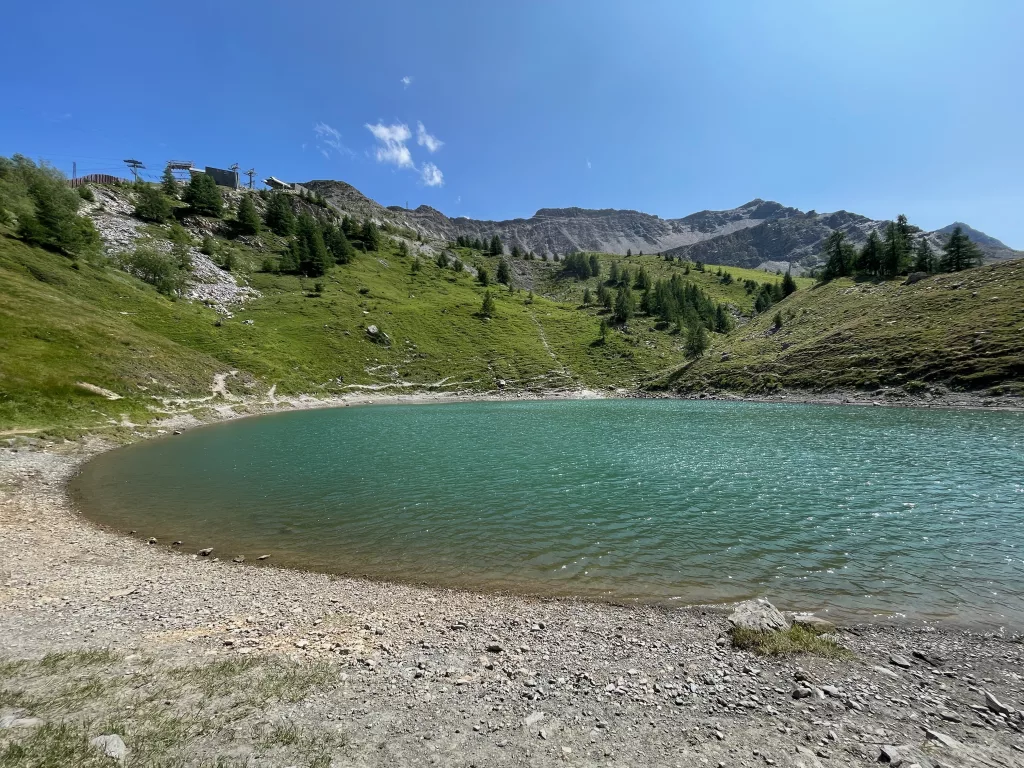
July 22nd, 2023. Trail conditions: Rifugio Combal-Maison Vieille

The trail that climbs from Lago Combal up to Arp Vieille Superiore, then to Lago Checrouit and Rifugio Maison Vieille was free of snow and in very good conditions. Most of the huts/refugees from the ski area are open and serve meals or drinks. One or two bridges were also installed where the path crossed some small streams.

If you go from Lago Combal to Maison Vieille, just before Maison Vieille there is a very dusty path that can get muddy and slippery in bad weather.

In the Val Veny there is a free shuttle bus from the Courmayeur central bus station up to La Visaille (~40-50min walk from Lago Combal). You can find the full timetable on the operator’s website and in this PDF.
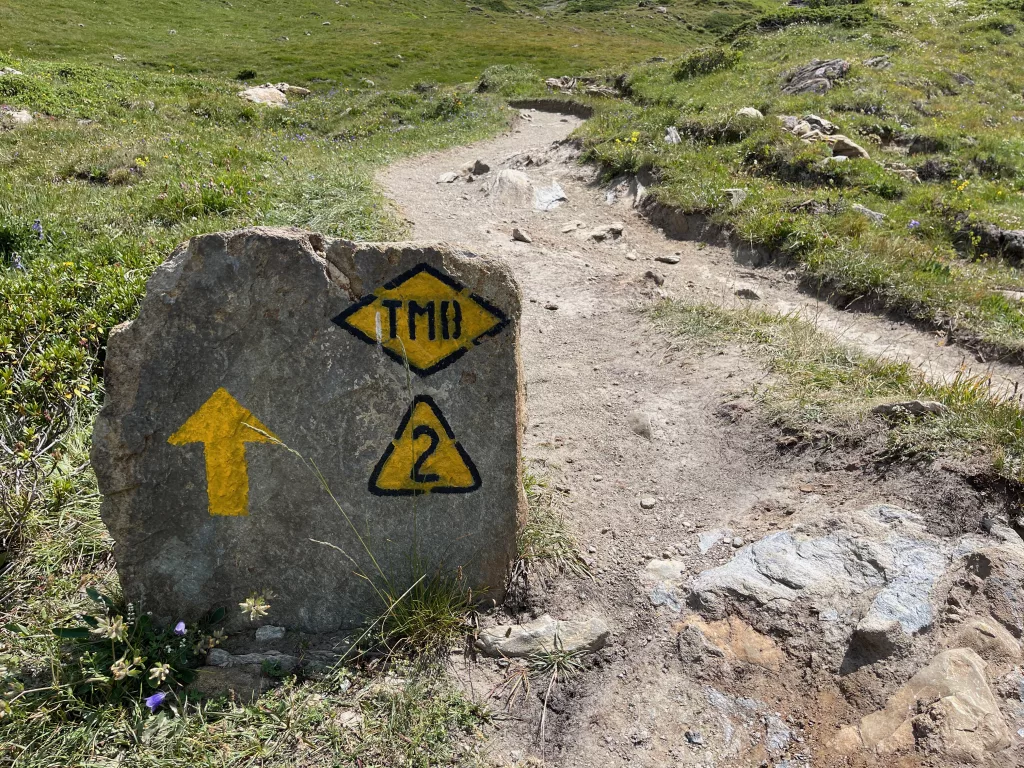
If you are doing the TMB towards Courmayeur and feel pretty tired, I strongly suggest taking the cable from Maison Vieille to Courmayeur (one chairlift and one gondola – 15€ for both), as the trail is very steep and mostly on the ski pistes.

Related

Latest posts

Categories

Planning your TMB? I built a complete Google Sheets planner with route data, accommodation tracker, budget tracker and gear list — available on Etsy.

July 21st, 2023. Trail conditions: Courmayeur-Bertone-Bonatti - Tour du Mont Blanc Hike

July 21st, 2023. Trail conditions: Courmayeur-Bertone-Bonatti

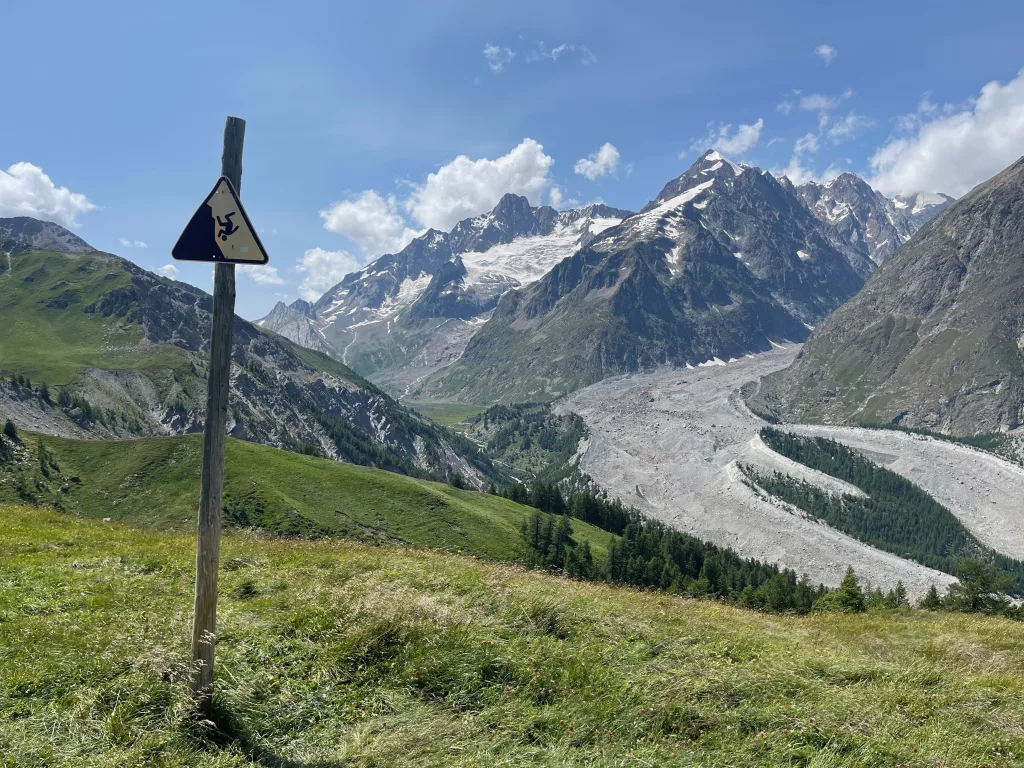
The trail from Courmayeur up to Rifugio Bertone, Rifugio Bonatti and then to the end of the Val Ferret was in perfect conditions. All the snow is gone and the bridges are into place. There were a few places where the trail looked rebuilt after the melting of the snow. It is probably one of the nicest and runnable trails in the Mont Blanc region.

There is a free shuttle bus (the green line) between Courmayeur main bus station and Val Ferret that goes every half an hour, between 7:30 and 18:30-19. You can find the full timetable on the operator’s website and in this PDF.
Related

Latest posts

Categories

Planning your TMB? I built a complete Google Sheets planner with route data, accommodation tracker, budget tracker and gear list — available on Etsy.

June 8th, 2023. Snow conditions: Les Houches - Courmayeur - Tour du Mont Blanc Hike

June 8th, 2023. Snow conditions: Les Houches – Courmayeur

Comparing to the same date last year, this year the TMB has a lot more snow (maybe between 50 and 100cms more) and the snow line starts lower in most of the parts of the route (1700-1800m). 2022 was a very dry year, so looking over trip reports from early June 2022 might look similar to what you can expect this year up to 2 or 3 weeks later.

Les Houches – Les Contamines

  • Bionnassay bridge is set
  • No snow from Les Houches to Col de Voza
  • Some snow up to Col de Tricot, but not difficult to hike in and there are good marks already. It will probably go away in a few weeks.

Les Contamines – Refuge du Col de la Croix du Bonhomme

  • The snow starts at Plan Jovet, right after the Refuge de la Balme, at ~2000m alt.
  • The climb to Col du Bonhomme was mostly on snow, the last part being quite steep. The poles and spikes definitely helped. In the Col the snow depth was probably around 2 meters (as high as the sign pole), so it will be there for a while.
  • From the Col du Bonhomme the traverse to the left towards Refuge du Col de la Croix du Bonhomme was also covered with snow. In some places the slope is steeper (close to 45 degrees) and it might be sketchy with no spikes.

Refuge du Col de la Croix du Bonhomme – Courmayeur

  • Path up to Col des Fours and then to Col de la Seigne still had a lot of firm snow and the microspikes can help a lot. Snow bridges started to form and might become sketchy until the snow clears completely.
  • The alternative, through Les Chapieux, is much easier and has a lot less snow as it goes down to the valley, although there are still some big steep snow patches on the climb to Col de la Seigne.
  • Going down to Italy the snow line was just below Rifugio Elisabeta. As the way down is not too steep, it can be fine without spikes. The refuge was already open and welcomes you with great espresso and sometimes even with cakes 🙂
  • The valley trail towards Courmayeur is clear of snow from the road below Elisabeta.

Related

Latest posts

Categories

Planning your TMB? I built a complete Google Sheets planner with route data, accommodation tracker, budget tracker and gear list — available on Etsy.

June 9th, 2023. Snow conditions: Courmayeur - Champex Lac - Tour du Mont Blanc Hike

June 9th, 2023. Snow conditions: Courmayeur – Champex Lac

The trail to Refugio Elena still has some steep snow patches that can be challenging due to the exposed terrain. Additionally, the wooden bridge crossing the stream is broken, and the snow bridge over it is at risk of collapsing soon, making it impossible to go around. It might be a safer choice to take the road instead of the path on the right side of the valley as you climb from Courmayeur.

Up to Grand Col Ferret, the path is mostly free of snow but quite wet, with some streams flowing over the trail. The col itself has significant snow coverage on both sides, but the descent into Switzerland is not too steep, so the snow should not cause major difficulties.

Once you descend into the valley, the path is well-maintained. As you begin the ascent towards Champex Lac, there is an enjoyable and educational trail featuring wooden carvings of plants and animals. You’ll also find informative signs providing details about different species of mushrooms. Please note that there is a detour from the traditional TMB route due to a logging project, but it is well-marked and should not pose any problems.

Related

Latest posts

Categories

Planning your TMB? I built a complete Google Sheets planner with route data, accommodation tracker, budget tracker and gear list — available on Etsy.

July 3rd, 2023. Snow conditions: Fenetre D’Arpette - Tour du Mont Blanc Hike

July 3rd, 2023. Snow conditions: Fenetre D’Arpette

Update: July 3rd 2023

The path is mostly free of snow, with only two short sections on the Champex side of the col still covered. Furthermore, the previously missing chains have been restored, greatly assisting in navigating areas affected by small landslides.


Original post (June 10th)

Choosing the alternative high route (up to ~2650m) to the TMB from Champex Lac may not be advisable at this early stage of the season. As soon as the ascent began, there were sections where the path was completely overgrown, and snow appeared around 2100m. The conditions felt unsafe with just microspikes and trekking poles, given the exposure and the hard snow. Additionally, some chains were missing in lower areas without snow (they may be reinstalled in a few weeks), which would have been helpful. Opting for the low route is likely the best option until the snow clears.

Related

Latest posts

Categories

Planning your TMB? I built a complete Google Sheets planner with route data, accommodation tracker, budget tracker and gear list — available on Etsy.

Where to stay in Chamonix - 2026 Top Picks - Tour du Mont Blanc Hike

Where to stay in Chamonix – 2026 Top Picks

When planning a trip to Chamonix, one of the key considerations is finding the right accommodation that fits your budget and meets your travel needs. Whether you’re a backpacker on a shoestring budget, a mid-range traveler looking for comfort and value, or a luxury seeker in search of premium experiences, Chamonix offers a wide range of lodging options to cater to every traveler’s preferences. 

With that in mind, below you can explore the diverse accommodation choices available in Chamonix, divided into three distinct sections: hostels and budget hotels for money-conscious adventurers, mid-range options for those seeking a balance between affordability and comfort, and luxury accommodations for those seeking la crème de la crème. If you get to the end of the post, you can also find a hotel that provides a completely immersive experience in the alpine setting.

Free transport for any paid accommodation in Arve Valley

If you are staying in the Arve Valley (Chamonix and its surroundings), getting around between Servoz and Vallorcine is free with a “Carte d’Hote”. Ask your host for this “Guest Card”, whether you stay in a hotel/hostel or in a private apartment. Some private apartment owners don’t provide it, in which case you need to go to the Tourist Office and show the booking confirmation. The Mont Blanc Express (the red panoramic train that goes through the Arve Valley) also goes to Saint-Gervais/Les Fayet in France and to Martigny (Switzerland), but a ticket must be bought after Servoz/Vallorcine.

Carte d’hote – Guest Cards that allow free transport on the Chamonix Valley, between Servoz and Vallorcine

The timetable for the Mont Blanc Express (until 17th of september 2023) can be found here.

Hostels and Budget Hotels

Chamonix Lodge

Chamonix Lodge, overall the best hostel in Chamonix

The hostel is located in a quiet neighborhood, a 15 mins walk from downtown, and it provides easy access to the town’s attractions and outdoor activities. It features a communal kitchen, a cozy lounge area, and a friendly atmosphere, making it the best choice for budget-conscious travelers.

  • + free breakfast
  • + free bag storage
  • – 15 min walk to downtown
  • – some people complain in the online reviews about the cleanliness of the place, so it might be a matter of luck

Vert Lodge

Vert Lodge Chamonix during winter

Located in a quiet area, close to Lac des Gaillans, this is a very hip and affordable hostel/hotel, owned and operated by mountain lovers. The lake is great for gazing at the mountains and chilling by the water. There is also a very popular rock climbing cliff just across the street from the lake.

  • + free breakfast
  • + free bag storage
  • + recently renovated
  • – 15-20 mins walk to downtown
  • – moderate soundproofing

Auberge de Jeunesse HI

Auberge du Jeunesse HI and its great patio

Good value hostel with a bar, pool table, board games and a lounge area with a lot of books. There is also a garden with a ping-pong table and a terrace.

  • + breakfast included
  • – no kitchen or sink, just a fridge in the communal area
  • – no WiFi and poor cell service in the rooms

Chalet-Gite Chamoniard Volant

Chalet Gite Chamoniard Volant

Chalet-Gite Chamoniard Volant is the most affordable hostel in Chamonix and one of the few with free car parking.

  • + free onsite car park
  • + self catering kitchen available
  • – breakfast not included, but can be ordered
  • – no lockers

La Folie Douce Hotel

La Folie Douce, a great affordable hotel with pool where you can easily make new connections

Very close to the parking for the Brevent cable car, La Folie Douce is the only place you can ski in and out of town during the winter. 

  • + outdoor swimming pool & spa
  • + gym
  • – breakfast not included, but there are many good restaurants withing the compound

RockyPop Hotel

RockyPop Hotel with its modern entrance

Not really a hostel, RockyPop is a great value 3 star location that offers 148 comfortable rooms (for 1-3 people). It’s probably one of the best places to stay in Chamonix for having fun and meeting new people.

  • + great food area, designed like a food court
  • + very comfortable modern private rooms
  • + cocktail bar, arcade games and sometimes live music
  • – pricier than the other hostels from above

Gite Refuge Le Moulin

Gite Refuge Le Moulin with its great outdoor terrace

Great friendly mountain getaway in a quiet location, up the Arve valley. The Gite is located between the Tour and Argentiere glaciers, so you have a great view all around. The bus station is 50m away while the train station (Montroc Le Planet) is 300m away.

  • + halfboard included between June and September
  • + gear room
  • – not in Chamonix center; it takes up to 30mins via bus or train to get there

Auberge La Boerne

The lovely terrace from Auberge La Boerne

La Boeme is a perfect base camp for hikers and mountaineers during the summer and for winter sports (ski, snowboard, hiking and snowshoeing) in the cold season. Built in the eighteenth century, the alpine chalet was initially a farm which transformed over time to what it is today: a friendly place to enjoy the mountains surrounding it. The train station (Montroc Le Planet) is 900m away.

  • + great traditional and savoyard cuisine, with fresh local products
  • + camping spots available. Tents can also be provided on request
  • + small grocery store available
  • – not in Chamonix center; it takes up to 30 mins via bus or train to get there

Mid-range Hotels

Hotel Les Lanchers ***

Hotel Les Lanchers

This is a family-run establishment known for its warm hospitality and reasonable rates. Situated near the Flégère cable car, it offers easy access to the ski slopes and hiking trails. The free parking, comfortable rooms, stunning mountain views, and a cozy lounge make it an excellent choice for budget-conscious travelers.

Hotel Pointe Isabelle ***

Hotel Pointe Isabelle

Located in the center of Chamonix, just a 1 minute walk from the Chamonix Train Station, Hotel Pointe Isabelle offers a budget-friendly option without compromising on quality. The cozy rooms feature stunning views of the Mont Blanc range, and the hotel provides amenities such as a sauna and a restaurant serving traditional Savoyard cuisine.

Le Chamonix **

Hotel Le Chamonix, with the Office de Haute Montagne in the background

Le Chamonix is a charming bed and breakfast that offers a comfortable and affordable stay. With quiet rooms, a communal lounge area, and a delicious breakfast, it provides a homely atmosphere for guests. Its central location, just across the square from the Tourist Information Center and the Office de Haute Montagne, allows easy access to Chamonix’s shops, restaurants, and outdoor activities.

Hotel Vallée Blanche ***

The Statue of Horace Bénédict de Saussure and Jacques Balmat pointing towards Mont Blanc, with Hotel Vallée Blanche in the background

Hotel Vallée Blanche is a family-run hotel with a focus on convenience and comfort. Located on the banks of the Arve River, near the Aiguille du Midi cable car, it provides easy access to the slopes and hiking trails. This 18th century hotel features clean and comfortable rooms, a welcoming staff, and an on-site restaurant serving local specialties.

Le Faucigny Hotel ***

Hotel Le Faucigny with its modern and green inside courtyard

Le Faucigny Hotel is a stylish yet affordable option in the heart of Chamonix. The contemporary rooms feature modern amenities, and the hotel offers a bar, lounge area, and a terrace with panoramic views of Mont Blanc. Its central location ensures easy access to the town’s attractions and transportation links. The daily buffet breakfast is served in a nice wood-paneled breakfast room (by the fireplace, in the cold season).

Auberge du Manoir ***

Auberge du Manoir with its lush terrace

Auberge du Manoir is a charming mountain inn offering a peaceful and affordable retreat. The hotel is surrounded by a big garden with a great relaxation area, and the interior with plenty of wood is a true reflection of a chalet from the Alps.

Plan B Hotel – Living ***

The big food area of Plan B Hotel – Living

Situated just next to the bus station from Chamonix Sud, Plan B Hotel features modern rooms with a big shared lounge with a pool table, terrace, a restaurant and even a bowling area and arcade games. After the hike you can also relax in the on site sauna. The hotel’s location makes it an extremely convenient choice if you plan on arriving to Chamonix by bus, being just a few meters away from the bus station.

Hotel Cosmique ***

The patio of Hotel Cosmiques, where you can enjoy a great brunch, lunch or dinner looking at Mont Blanc

Hotel Cosmiques promises a delightful stay in Chamonix, characterized by genuine hospitality, a unique ambiance, and a convenient location. Based in the center of the resort, the hotel has a very modern vibe with the colorful decoration and very cute (although small) rooms. The coffee shop/bar/brunch spot downstairs and the big terrace strongly reinforce the hipness of the place.

Luxury Hotels

Hotel Les Granges d’en Haut *****

Hotel Les Granges d’en Haut provides an affordable luxury experience close to Chamonix. Located in Les Houches, a short distance from Chamonix, this boutique hotel offers stylish chalet-style rooms, a spa, and stunning views of the Mont Blanc massif. Here you can also enjoy a gourmet dining experience.

Hôtel Mont Blanc Chamonix *****

Hotel Mont Blanc with its large terrace and outdoor swimming pool

Hôtel Mont Blanc Chamonix epitomizes luxury and refinement. Located near the Tourist Information Center and the Office de Haute Montagne, this premium hotel offers tastefully decorated rooms and suites that exude elegance and comfort. With its gourmet restaurant, spa, outdoor swimming pool and breathtaking views of Mont Blanc, it promises a truly indulgent experience.

Le Hameau Albert 1er *****

Le Hameau Albert 1er offers a serene and luxurious retreat in the heart of Chamonix. This family-run hotel boasts elegantly furnished rooms, a Michelin-starred restaurant, and a world-class spa. Set amidst lush gardens with stunning mountain views, it provides an oasis of tranquility. In a few minutes you can walk to the Chamonix Central train station or to Montenvers Train Station.

Les Rives d’Argentière *****

View from the chalets from Les Rives d’Argentière

Les Rives d’Argentière is a collection of luxury chalets nestled in the charming village of Argentière, just a short drive from Chamonix. These spacious and beautifully designed houses feature contemporary Alpine décor, fully equipped kitchens, and private balconies. Guests can enjoy access to the on-site spa and wellness facilities.

Grand Hôtel des Alpes *****

Grand Hôtel des Alpes, located in the heart of Chamonix, is a luxurious retreat offering a blend of elegance and alpine charm. The stylishly decorated rooms and suites provide modern comforts and breathtaking mountain views. Here you can unwind in the hotel’s spa, savor gourmet cuisine, or simply relax in the cozy lounge area.

Le Morgane ****

Le Morgane is a boutique hotel that combines contemporary design with alpine charm. Located in the town center, it offers sleek and stylish rooms and suites, a gourmet restaurant, and a lovely spa with stunning views of Mont Blanc. The hotel’s central location provides easy access to Chamonix’s attractions, shops, and restaurants.

Les Grands Montets Hotel & Spa ****

This chalet sits below the famous ski area of the Grands Montets and at the starting point for a range of hiking trails. Its spacious rooms (some with mezzanines for families) have a view of Mont-Blanc or the Glacier of Argentière. The chalet-style rooms and suites offer bright and cosy living spaces. Inside the spa area you can find an indoor swimming pool, outdoor hot-tub, a sauna, fitness room and a steam room.

One of a Kind Stays

Refuge du Montenvers

Refuge du Montenvers (1,913m) and the iconic red cog-wheel train

Only accessible by train, departing from Montenvers-Mer de Glace Train Station, Refuge du Montenvers is a shelter-style hotel set in a 19th-century building and located at an altitude of 1913 meters just across the Mer de Glace Glacier. From the Restaurant Le Montenvers which features French regional cuisine you can admire the Grandes Jorasses, Les Drus and the Aiguilles Rouges.

As of 11th of July 2023, the hotel restaurant is closed during lunchtime until further notice. You can still have some on-site meals at the Bar des Glaciers.

Frequently Asked Questions

Here are some questions that people often ask about accommodation in Chamonix.

Are there cheap places to sleep in Chamonix?

If your budget is tight, you can find some affordable hostels or budget hotels. In the high season (15th of June – 1st of September and during the snow season) they tend to fill up pretty quickly. Sometimes you can also get a good deal on an apartment on Airbnb or Booking.

When should I book my stay?

Although you can probably find a place for the same day even in the high season, you might have to pay extra. Chamonix tends to get very crowded during the summer and the winter (especially if the forecast says heavy snow), so it might be best to book at least a few weeks or months in advance, in order to find the perfect accommodation for your taste and budget.

Should I book a hostel, an apartment or a hotel?

It depends.
If your budget is tight or you don’t mind sharing the room with other people, a hostel might work for you. For a period longer than a few days, an apartment might be more confortable and more spacious than a hotel room for a similar budget. If you prefer breakfast, daily cleaning and fresh towels and bedsheets, than a hotel might be the best choice.

Related

Latest posts

Categories

Planning your TMB? I built a complete Google Sheets planner with route data, accommodation tracker, budget tracker and gear list — available on Etsy.

Money on the TMB: A Comprehensive Guide - Tour du Mont Blanc Hike

Money on the TMB: A Comprehensive Guide

Embarking on the Tour du Mont Blanc (TMB) promises a journey of breathtaking vistas, challenging trails, and immersive cultural experiences. However, amidst the rugged beauty of the Alps, there lies a practical consideration: money. As you traverse through picturesque landscapes and quaint villages, understanding the nuances of currency usage becomes crucial. With several refuges accepting only cash and varying payment methods along the route, prudent financial planning ensures a seamless adventure.

The TMB spans across France (€), Italy (€), and Switzerland (Swiss Francs – CHF), each with its own currency norms. While credit cards are becoming widely accepted, certain refuges exclusively deal in cash.

Cash-Only Refuges:

  1. Refuge Miage
  2. Auberge du Truc
  3. Refuge Nant Borrant
  4. Auberge de la Nova
  5. Refuge Mottets
  6. Refugio Bertone
  7. Refugio Bonatti (they allow card payments over a specific amount – 10 or 20 euros, I can’t remember exactly)
  8. Refuge Bellachat

ATMs along Tour du Mont Blanc

Along the route you will find plenty of ATM machines, so it’s not the end of the world if you don’t bring the cash from home. Just remember that some of the ATMs charge a withdrawal fee and some of the card providers charge one as well (or have a maximum monthly limit below which they don’t charge anything). When you use an ATM, you usually see only the former (as the other one depends on the card provider)

  • Chamonix has plenty of ATMs all over the place, as it is a very popular little town
  • Les Houches: there are two cash machines, one at CA des Savoie Bank near the Tourist Office and one in the tobacco shop (Aux Armes de Savoie)
  • Les Contamines: there are three ATMs just in the city center, close to the Tourism Office. They are within 50m of each other.
  • Courmayeur: here you have plenty of options, as it’s a bigger mountain town.
  • La Fouly: there is one ATM at the Tourism Office
  • Champex Lac: here you can find one ATM next to the Champex Lac

Currency Exchange in Switzerland:

In the Swiss part of the hike, you can use Euro bills for transactions, but coins may not be accepted. ATMs are plentiful along the route, offering convenient access to Swiss Francs or Euros as needed.

Optimizing Financial Transactions

  1. Carry Sufficient Cash: Before embarking on the TMB, ensure you have an ample supply of cash in Euros and Swiss Francs to cover expenses at cash-only refuges and other instances where cards may not be accepted. When I did the hike in 2022, I used around 200 swiss francs and maybe 300 euros along the way (for 2 people)
  2. Use Revolut for Currency Exchange: If you’re traveling from a country that doesn’t use Euros as its primary currency, leveraging services like Revolut can be advantageous. If you don’t have an account yet, sign up with this link and get 3 months of Free Premium. That gives you free cash withdrawal (up to 400 euros per month), unlimited currency exchange with really good rates and no additional fees, among other perks (such as discounted Airport Lounge access to make your trip less of a burden).
  3. Monitor Exchange Rates: Stay informed about exchange rates to make informed decisions regarding currency exchange. Revolut and other similar platforms often provide real-time updates, allowing you to exchange currency at opportune moments. Just remember: if you exchange currency during the weekend, you will need to pay an additional tax (between 1-5%, depending on the bank). The same applies if you withdraw cash from a card that has a different currency.
  4. Emergency Fund: Keep a reserve of cash for emergencies or situations where card transactions may not be feasible. This ensures you’re prepared for any unexpected circumstances that may arise during the hike.

Practical Tips for Financial Preparedness

  1. ATM Accessibility: Familiarize yourself with the locations of ATMs along the route to ensure convenient access to cash when needed. Plan your itinerary accordingly to include stops at towns or villages with ATM facilities.
  2. Divide Funds: Consider splitting your cash into smaller denominations and distributing it across different pockets or bags. This minimizes the risk of loss or theft and ensures you have access to funds even if one portion is compromised.
  3. Inform Your Bank: If you plan to use your credit or debit card during the hike, inform your bank beforehand to prevent any potential blocks on your card due to international transactions. Some banks now use a geolocation safety mechanism, so they may block the card usage if something looks suspicious (e.g.: the phone with the bank app connected to the account is not in the same country as the card)
  4. Be Mindful of Exchange Rates: While using Euro bills in Switzerland is permissible, be mindful of potential exchange rate discrepancies. Evaluate whether it’s more cost-effective to use Euros or Swiss Francs for transactions based on prevailing rates.

Conclusion

Embarking on the Tour du Mont Blanc is not just a physical endeavor but also a logistical one, requiring careful planning, especially when it comes to finances. By understanding the currency dynamics, leveraging convenient payment options, and adopting prudent financial practices, you can navigate the monetary aspects of the TMB with confidence. Whether it’s enjoying a hearty meal at a refuge or savoring the stunning vistas of the Alps, ensuring your financial preparedness enhances the overall experience of this iconic trek. So, lace up your hiking boots, pack your currency essentials, and embark on an adventure of a lifetime amidst the awe-inspiring beauty of the Mont Blanc massif.

Related

Latest posts

Categories

Planning your TMB? I built a complete Google Sheets planner with route data, accommodation tracker, budget tracker and gear list — available on Etsy.

Snow conditions and weather on TMB - Tour du Mont Blanc Hike

Snow conditions and weather on TMB

For weather forecasts, the most reliable options are:

Each beginning of the season we try to get a summary of the snow conditions from the trail (either going there or checking with people that are doing the hike early) and post them in the news area.

Below you can get a quick glance at the forecasts for several places along the TMB.

Weather in Chamonix

Weather in Le Brevent

Weather in Col du Bonhomme

Weather in Courmayeur

Weather in Col Ferret

Weather in Champex Lac

Related

Latest posts

Categories

Planning your TMB? I built a complete Google Sheets planner with route data, accommodation tracker, budget tracker and gear list — available on Etsy.

TMB Accommodation for 2026 Season - Tour du Mont Blanc Hike

TMB Accommodation for 2026 Season

Last updated: 31 March 2026

2026 just started, but that doesn’t mean it’s too early to start planning for the summer of 2026. Due to its increasing popularity, some of the places along the route become booked out even 9-12 months before the season. Others accept bookings only a few months before opening. Because of that, you have to check and re-check every now and then to make sure you won’t end up without a place to sleep in for one of the many days of the route.

There are already several dates in the 2026 summer with booked out accommodations. Make sure to book in advance if you want to stay in one of the mountain huts with very limited space.

Below you can find a list of properties along the route and their booking status for the 2026 season, sorted in a counter clockwise direction starting from Les Houches (as this is the “official” starting point of the TMB and the most popular direction of doing the hike).

Watch out! At some of the refuges along the way you can pay only cash, as they don’t accept credit/debit cards. They are marked accordingly below. More information about the money situation on the hike you can find on the TMB money guide.

In Chamonix there are plenty of places to choose from, most of them open year round. You can find some of the top picks here, sorted by price range and type.

Related

Latest posts

Categories

Planning your TMB? I built a complete Google Sheets planner with route data, accommodation tracker, budget tracker and gear list — available on Etsy.

Things to do in Courmayeur - Tour du Mont Blanc Hike

Things to do in Courmayeur

Courmayeur is a charming alpine village on the Italian side of Mont Blanc. Right at the end of Aosta Valley, it is also the last town before crossing from Italy to France via the Mont Blanc Tunnel. If you are planning to do the Tour du Mont Blanc hike, you can either start from here or start from Chamonix and reach the middle of the trek here. Although it’s not mandatory to take a break when doing the TMB from Chamonix, taking a rest day might be a great boost of morale and a good opportunity to enjoy the local amenities.

Skyway Monte Bianco Cable Car

Photo by Luca Maffeis on Unsplash

One of the most spectacular cablecar rides in the Alps, the Skyway Monte Bianco takes you from Courmayeur (1,224m) up to the Pavillon du Mont Frety (The Mountain Station, 2,173 m) and Punta Helbronner (The Sky Station, 3,466 m).

At the middle station you can find a large terrace that rewards you with a 180° view of Mont Blanc and Val Veny. Inside the station you can find a bar, a restaurant, and even a private cinema hall, that sometimes hosts public or private events. Another highlight of the Pavillon station is the Cave Mont Blanc, that offers unique experiments with winemaking at high altitudes, especially sparkling wine. The combination of altitude, atmospheric pressure and temperature give the sparkling wine some very rare characteristics. In the rooms of the old station you can find Hangar 2173, a small museum like place filled with the history and prestige of the old cable cars. If the weather is good, don’t forget to visit the alpine botanical garden, with its 900 species from all over the world.

Once you reach the upper station of Skyway Monte Bianco – Punta Helbronner / The Sky, you can enjoy a 360° panorama from the circular terrace. The station also has a crystal room filled with a big variety of crystals, a glass room (Sky Vertigo) where you can enjoy the feeling of walking in the void and the Kartell Bistrot Panoramic, where you can enjoy a drink and a lunch at high altitude.

Baita La Suche

Image from Hotel Croux’s website

Baita La Suche (also known as Alessio Allegri Chalet) is an alpine pasture hut located on a beautiful balcony close to Courmayeur and offers a great view of the Mont Blanc range. At a height of 1,816m, the hut can be accessed from Ermitage through a 50-60 minutes walk.

The Alpine Museum

Mountaineering boots from 1952 used in K2, seen at the Courmayeur Alpine Museum

Located right in the center of Courmayeur, the Alpine Museum was opened in 1929 and it’s full of objects, photographs and stories about the evolution of mountaineering and mountain guides’ activities.

Dollone

Right across the river from the city center lies the cosy old village of Dollone. Home to the Courmayeur Sports Centre, one of the most well equipped sports facilities in Europe, Dollone is filled with old buildings and picturesque narrow alleys.

Cosy street in Dolonne

Related

Latest posts

Categories

Planning your TMB? I built a complete Google Sheets planner with route data, accommodation tracker, budget tracker and gear list — available on Etsy.

Things to do in Chamonix - Tour du Mont Blanc Hike

Things to do in Chamonix

Staying in Chamonix before or after doing the TMB hike is a must if you have the time for it. Being the cradle of alpinism and mountaineering, Chamonix has the highest diversity and quality of the climbing and mountain culture that the Alps offer. Everywhere you go you can almost feel the history and the heritage surrounding you. Although is hard to stay in town with the spectacular surroundings, if you decide to do that there plenty of “non sport” activities to choose from: dozens of charming shops, cozy streetside cafes, lots of food options (ranging from sandwiches and pizza to fine dining), spectacular tram and cable cars ride and so on.

Aiguille du Midi

Photo by Jonathan Ansel Moy de Vitry on Unsplash

The iconic rock needle, Aiguille du Midi, is one of the first things you see on a clear day when you look around from Chamonix. Standing at 3,842m, this summit is easily accessible with a cable car, which also holds the world record as the highest vertical ascent cable car in the world, starting from 1,035m. There are two sections: from Chamonix to Plan de l’Aiguille (2,317 m) and from Plan de l’Aiguille to the upper station (3,777m), from where you can take an elevator to get to the actual summit. The upper station features a café, a viewing platform, a gift shop, a panoramic tubular walkway that surrounds the summit and a glass skywalk called “Step into the Void”.

Even if the weather in Chamonix might get hot during the summer, you should definitely take warm clothes and sunglasses if you plan to go all the way to the upper station. The temperature on the open viewing platform can easily drop below -10 degrees even in summer.

From the upper station during the summer months you can take the spectacular Panoramic Mont Blanc Cable Car (over Vallee Blanche) to Pointe Helbronner (3,462m), a summit on the italian side on Mont Blanc and from there down to Courmayeur, via Skyway Monte Bianco. This is definitely the more scenic way to get from one side of the mountain to the other, although it is much more expensive than taking the highway through the Mont Blanc Tunnel.

You can check the latest ticket prices and timetables for the cable cars below:

Montenvers Tram

Photo by Gregory DALLEAU on Unsplash

The little red cogwheel train might look very familiar, as it is on many postcards and travel posters all over the Alps. Opened in 1909, the train takes you from Chamonix (1,035m) to Montenvers station (1,913m), just above the famous Mer de Glace glacier. Right across the glacier you can see the north faces of Grandes Jorasses, Drus and Aiguille Verte.

From the upper station of the train you can go with a small cable car or by foot down to the valley, where you can literally step inside the glacier, in the Ice Cave.

Another good place to visit 5 minutes away from the train station is the Glaciorium, a small museum where you can learn and understand the history and evolution of Mer de Glace. Unfortunately, the signs of global warning are visible with the naked eye, as the glacier keeps retreating more and more with each passing year.

After you finish the visits, you can enjoy a drink or a meal at the Montenvers hotel or at the cafe near the train station. If you have one or two nights to spare, you can even sleep at Montenvers hotel for an unforgettable experience.

For ticket prices and timetables, you can check their website.

Brevent and Le Panoramic Restaurant

Photo by Ricardo Frantz on Unsplash

On the other side of the valley, opposite to Aiguille du Midi, you can go up with the Brevent cable car to get a new angle towards Mont Blanc. If you go all the way to the upper station (2,505m), you can enjoy a meal or some drinks with a spectacular view accross the Chamonix Valley. There are also some restaurant around the middle station, in Planpraz.

Parc de Merlet

Photo by Jeroen Roegist on Unsplash

Parc de Merlet is an animal park open and ran by the Cachat family from 1968. Perched at around 1,500m high, it offers a great panorama of the Mont Blanc range. The park administrators try to keep the park as sustainable as possible, so you will find a place very different than the regular zoos. Although it spreads over more than 52 acres, the animals are not confined by fences and are free to roam over the natural land, so they behave almost as they would in the wild.

The official website offers more information about the park, as well as a map with the two main trails which you can follow.

Paragliding

Photo by Sies Kranen on Unsplash

On a clear sky, you are definitely going to see lots of paragliders with colored chutes floating accross the Chamonix Valley. Some of them might even go close to the glaciers or the Mont Blanc summit. There are many companies that offer guided tandem paragliding, for which you don’t need any prior experience. TBC

The Crystal Museum

Photo by Jason D on Unsplash

After a more than two years long renovation, the museum reopened at the end of December 2021 with more than 1,900 crystals. The exhibits include a variety of different pieces from the Alps (France, Italy, Austria and Switzerland) and from other places around the world. Some of the stones are not covered by any glass so you can actually touch them.

You can find more information about the museum, ticket prices and visiting hours on the official website.

Related

Latest posts

Categories

Planning your TMB? I built a complete Google Sheets planner with route data, accommodation tracker, budget tracker and gear list — available on Etsy.

History of the TMB trail - Tour du Mont Blanc Hike

History of the TMB trail

Nestled in the heart of the awe-inspiring Alps, the Tour du Mont Blanc stands as a testament to both the grandeur of nature and the enduring spirit of human exploration. This iconic hiking trail, spanning approximately 170 kilometers (105 miles) and encircling Mont Blanc, the highest peak in the Alps, has a rich and captivating history that has unfolded over centuries.

While the formal creation of the Tour du Mont Blanc is a more recent development, the region has a history that dates back millennia. The area around Mont Blanc has long been inhabited by various Celtic tribes, leaving traces of their presence in ancient artifacts and burial sites. Later, the Roman Empire extended its influence into the region, and remnants of their civilization can still be found along the trail. Traces of ancient Roman roads, can still be found along the trail, serving as a testament to the rich historical heritage of the area.

First ascent of Mont Blanc

The Birth of the Ascent: In the late 18th century, the concept of mountaineering as a recreational pursuit began to take shape. The allure of conquering towering peaks and exploring uncharted territories gripped the imagination of intrepid explorers. It was against this backdrop that the idea of ascending Mont Blanc emerged, igniting a spark of curiosity and determination in the hearts of those seeking adventure.

Portrait of Horace Bexedict de Saussure, in the Library at Geneva

The Visionary: Horace-Bénédict de Saussure, a Swiss geologist, is often credited as the driving force behind the first ascent of Mont Blanc. Saussure’s determination and unwavering commitment laid the groundwork for the monumental achievement that would follow. Intrigued by the possibility of reaching the summit, Saussure conducted extensive studies of the region and eventually assembled a team of guides and porters to make an attempt. In 1760, he offered a reward to anyone who could reach the summit of Mont Blanc, igniting a spark of curiosity and adventure among intrepid explorers. A few years later, in 1767, he completed his first tour of Mont Blanc. During his expedition, he collected local flowers and did multiple experiments on the atmospheric pressure, magnetism and electricity.

Horace-Bénédict de Saussure monument at Chamonix. Jacques Balmat is pointing at Mont Blanc.

The Local Mountaineer: Jacques Balmat, a skilled mountain guide and crystal hunter from Chamonix, played a crucial role in the first ascent of Mont Blanc. Known for his intimate knowledge of the local terrain, Balmat possessed the skills and experience necessary to navigate the challenging conditions of the mountain. His collaboration with Saussure proved to be a pivotal partnership that would forever leave its mark on mountaineering history.

Michel-Gabriel Paccard – Monument erected at Chamonix

The Adventurous Physician: Michel-Gabriel Paccard, a young physician from Chamonix, joined forces with Balmat in the pursuit of conquering Mont Blanc. Despite his lack of mountaineering experience, Paccard’s unwavering determination and physical endurance proved to be instrumental in the success of the expedition. Together, Balmat and Paccard formed an indomitable team that would forever be remembered for their audacious ascent.

The Moment of Triumph: On August 8, 1786, after months of preparation and setbacks, Balmat and Paccard stood on the summit of Mont Blanc, becoming the first individuals in recorded history to reach the peak of this mighty mountain. The sense of accomplishment and awe they must have experienced is difficult to fathom, as they stood on the roof of Europe, gazing out at the vastness of the surrounding Alpine landscape. Balmat and Paccard’s triumph not only demonstrated the possibility of conquering the highest peaks but also kindled a fascination for the mountains in the hearts of people around the world.

The successful ascent of Mont Blanc by Balmat and Paccard had a profound impact on the world of mountaineering. It shattered the belief that such lofty heights were unattainable, inspiring a new wave of exploration and adventure in the Alps. The feat captured the imagination of people across Europe and beyond, and the name Mont Blanc became synonymous with human perseverance and the conquest of nature.

The first ascent of Mont Blanc laid the foundation for the development of mountaineering as a sport and a cultural phenomenon. It sparked a surge of interest in mountain exploration, leading to the establishment of alpine clubs, the development of climbing techniques, and the rise of renowned mountaineers who pushed the boundaries of what was thought possible.

As mountaineering gained popularity, safety and ethical considerations became increasingly important. The first ascent of Mont Blanc was achieved without the aid of modern equipment, relying solely on the skills and determination of Balmat and Paccard. You can see how the old equipment compares to today’s gear at two great alpine museums: The Alpine Museum Duca degli Abruzzi from Courmayeur and Musée Alpin from Chamonix. Exhibits showcase historical artifacts, photographs, and stories of daring climbers, further deepening the understanding of the region’s cultural and mountaineering heritage.

Creation of the Trail

Tour du Mont Blanc Map

In the early 20th century, efforts were made to create a trail that would encompass the beauty and grandeur of Mont Blanc and its surrounding landscapes. Local guides, mountaineering clubs, and organizations collaborated to establish a circular route that would offer hikers an immersive experience, enabling them to appreciate the diversity and natural beauty of the area.

The first comprehensive guidebook for the Tour du Mont Blanc, “Le Tour du Mont Blanc” by Charles Gos, was published in 1907. This guidebook provided valuable information on the route, elevations, accommodations, and the natural wonders to be encountered along the way. It served as a catalyst for the growing interest in hiking and exploring the Tour du Mont Blanc.

The task of mapping and formalizing the trail began in the 1920s. The French Alpine Club (Club Alpin Français) and other organizations worked tirelessly to connect existing paths, ancient trails, and mountain passes into a cohesive route. They aimed to create a trail that encircled Mont Blanc, passing through the stunning valleys and alpine meadows of France, Italy, and Switzerland.

Following World War II, the Tour du Mont Blanc experienced a resurgence in popularity. As the region recovered from the devastation of war, mountaineers and adventurers flocked to the area, drawn by its natural splendor and the allure of conquering Mont Blanc. With improvements in infrastructure, including the development of mountain huts and guesthouses, and the emergence of guide services, more people were able to undertake the challenging journey, further fueling the popularity of the trail.

The Development of Infrastructure

As hikers make their way through the picturesque alpine villages along the trail, they will also come across historical landmarks that have preserved their architectural charm and cultural heritage. In Courmayeur, Italy, the historic Church of Saint Pantaleon, with its stunning frescoes, stands as a testament to centuries of faith and devotion. In Switzerland, the quaint village of Champex-Lac features traditional Swiss chalets, some of which date back centuries, providing a glimpse into the traditional mountain lifestyle.

Over the years, the trail underwent several modifications and improvements. Local communities, tourism boards, and conservation organizations played a crucial role in maintaining and enhancing the trail’s infrastructure. Today, the Tour du Mont Blanc is a well-marked and well-maintained route that attracts thousands of hikers from around the world.

As the popularity of the Tour du Mont Blanc grew, infrastructure was developed to support hikers along the trail. Mountain huts, known as refuges, were constructed at strategic points, providing shelter and basic amenities for trekkers. These refuges serve as welcome resting places, allowing hikers to break their journey and enjoy the stunning surroundings.

Additionally, guesthouses, inns, and campsites were established in the charming alpine villages that dot the route. These accommodations provide opportunities for hikers to immerse themselves in the local culture, savor traditional cuisine, and interact with the hospitable mountain communities.

Experienced guides and tour operators also emerged, offering guided tours and logistical support for those embarking on the Tour du Mont Blanc. They provide valuable insights, safety measures, and route planning assistance, ensuring that hikers have a rewarding and enjoyable experience.

Cultural Encounters and Alpine Traditions

The Tour du Mont Blanc offers a unique opportunity to engage with the cultural heritage of the region. As hikers traverse through France, Italy, and Switzerland, they will encounter local traditions, customs, and cuisines. From savoring traditional alpine dishes, such as raclette and fondue, to witnessing vibrant festivals and celebrations, the trail presents a tapestry of cultural encounters that enrich the overall experience.

Conservation and Preservation

In recent decades, conservation and preservation efforts have played an essential role in protecting the fragile ecosystems and ensuring the sustainability of the Tour du Mont Blanc. Various organizations and initiatives have been established to promote responsible tourism, minimize environmental impact, and preserve the natural beauty of the area for future generations of hikers to enjoy.

The creation of protected areas, such as the Mont Blanc Natural Reserve, aims to preserve the unique flora and fauna of the region. Depending on when you plan on doing the hike, you can find a huge variety of alpine flowers and rare or endangered species of animals, such as the ibex and chamoix.

The principle of “Leave No Trace” is widely promoted along the trail. Hikers are encouraged to minimize their impact by practicing proper waste disposal, respecting wildlife, and staying on designated paths. By adhering to these guidelines, visitors can help preserve the pristine beauty of the landscapes.

Accommodation providers along the Tour du Mont Blanc are increasingly adopting sustainable practices. From eco-friendly lodges to energy-efficient facilities, efforts are made to minimize carbon footprint and waste generation. Additionally, some accommodations source local and organic produce, supporting the local economy and reducing transportation-related emissions.

Conclusion

The Tour du Mont Blanc is not merely a hike; it is a journey through time, nature, and human achievement. From the footsteps of ancient civilizations to the daring exploits of mountaineering pioneers, the trail weaves together a narrative of exploration, resilience, and reverence for the Alpine environment. As you embark on this extraordinary adventure, take a moment to appreciate the historical significance that envelops you, connecting you to the past while forging a path toward a more sustainable future. The Tour du Mont Blanc invites you to embrace the wonder of nature, and create your own enduring memories along this remarkable historical pathway while leaving no trace behind. Make sure to allow a day or two before or after the tour to taste the vibe from Chamonix and if the time allows, a rest day in Courmayeur.

Related

Latest posts

Categories

Planning your TMB? I built a complete Google Sheets planner with route data, accommodation tracker, budget tracker and gear list — available on Etsy.

Getting to Chamonix - Tour du Mont Blanc Hike

Getting to Chamonix

Chamonix is located in southeast France, in the Haute-Savoie district, and it sits just at the base of Mont Blanc (4810m), which is right at the border between France, Italy and Switzerland.

There are many ways to get to Chamonix, as it is close to many international airports and has good road and rail connections. Probably the fastest way to get there is to fly to Geneva (which is the second largest airport in Switzerland) and then get a transfer from the airport to the city of Chamonix. You can take a private or shared transfer, regular coach/bus or even a helicopter transfer.

The buses to Chamonix usually stop in the main bus station from Chamonix, in the south. Right next to the bus station there is a nice hotel, Plan B, which we highly recommend for spending the night. We really liked the place and we’ll probably stay there as well in our next trips in the area, because the hotel:

  • has many rooms, so finding one available might be easier than at the downtown hotels;
  • the rooms are very spacious, with good amenities and fast internet;
  • the breakfast is varied and quite good;
  • there is a luggage room where you can leave the baggage in your last day in Chamonix or while you’re hiking the TMB;
  • it’s really close to the bus station, so you don’t have to take a cab or haul your heavy bags through town.

Other close airports are listed below, with approximate driving times from each of them:

AirportDistance to ChamonixDriving time to ChamonixTickets
Geneva (GVA)100 km1h10Find best prices
Turin (TRN)173 km2h20Find best prices
Lyon (LYS)220 km2h15Find best prices
Grenoble (GNB)225 km2h20Find best prices
Milan Malpensa (MXP)235 km3h15Find best prices
Milan Bergamo (BGY)283 km4hFind best prices
Closest international airports to Chamonix

You can also get to Chamonix by train, using the French railroad (SNCF) or the Swiss railroad (ÖBB). This is by far the most eco friendly option, but might not always be very convenient. In June 2022, the connection with the Geneva airport was not so good (1 or 2 changes, about 3h30-4h of travelling).

Driving to Chamonix is also a good option that gives you greater flexibility in the valley and the car can provide you with a place to leave the extra gear. There are numerous paid and free parkings in the area, but bear in mind that parking right in the city center might be difficult and expensive. A parking guide for Chamonix can be read on the official city website (only in French) or this leaflet (only in French).

Related

Latest posts

Categories

Planning your TMB? I built a complete Google Sheets planner with route data, accommodation tracker, budget tracker and gear list — available on Etsy.

Off Days Archives - Tour du Mont Blanc Hike
Category

Off Days

Things to do in Courmayeur

Courmayeur is a charming alpine village on the Italian side of Mont...

Things to do in Chamonix

Staying in Chamonix before or after doing the TMB hike is a...

Latest posts

Planning your TMB? I built a complete Google Sheets planner with route data, accommodation tracker, budget tracker and gear list — available on Etsy.

Planning Archives - Tour du Mont Blanc Hike
Category

Planning

Where to stay in Chamonix – 2026 Top Picks

When planning a trip to Chamonix, one of the key considerations is...

Money on the TMB: A Comprehensive Guide

Embarking on the Tour du Mont Blanc (TMB) promises a journey of...

TMB Accommodation for 2026 Season

Last updated: 31 March 2026 2026 just started, but that doesn't mean it's...

History of the TMB trail

Nestled in the heart of the awe-inspiring Alps, the Tour du Mont...

Training Tips

Embarking on the TMB hike is an exciting adventure that offers breathtaking...

Getting started

The Tour du Mont Blanc (TMB) is probably the most popular hiking...

Things to do in Courmayeur

Courmayeur is a charming alpine village on the Italian side of Mont...

Things to do in Chamonix

Staying in Chamonix before or after doing the TMB hike is a...

Snow conditions and weather on TMB

For weather forecasts, the most reliable options are: Chamonix.net Meteoblue Chamonix-meteo.com Each beginning of the season...

Getting to Chamonix

Chamonix is located in southeast France, in the Haute-Savoie district, and it...

Latest posts

Planning your TMB? I built a complete Google Sheets planner with route data, accommodation tracker, budget tracker and gear list — available on Etsy.

Trip report 2022 - Tour du Mont Blanc Hike

Trip report 2022

The Tour du Mont Blanc (TMB) is probably the most popular hiking route in the world. Typically, the season starts from June 15th and ends somewhere after mid September, with the most crowded period occurring in July and August. We decided to do the hike at the end of May/beginning of June (May 30th – June 9th), and didn’t book any accommodations in advance. This meant that we had some constraints when planning our stages due to closed huts along the trek. When we first arrived in Chamonix, we went to Haute Montagne to get some information about the conditions on the route. Although the winter of 21/22 was probably the driest winters in the last 10-20 years, because it was so early there were still many patches of snow along the trail. Below you can read a report from our trip.

If you are looking for a place to stay in Chamonix before or after doing the TMB, we made up a list of some of the best accommodations for every budget.

Day 1 – Montroc – La Flegere – Chamonix

21 km / 1200m D+

Powered by Wikiloc

We had to take a different approach for this stage of the Tour du Mont Blanc because the La Flegere hut and the two cable cars from Chamonix were all closed. Instead, we took the train from Chamonix to Montroc and hiked back to Chamonix at the end of the day. This allowed us to hike with a light pack, since we left the rest of our gear in Chamonix.

Alpine flowers close to a hut near Montroc
Plenty of flowers on the route at the beginning of the summer

From Montroc, there are two trails to choose from: the more challenging and exposed “Ladder” trail through Aiguillette d’Argentiere, and the more moderate trail through Col de Montets. We decided to take the first one, as the weather was good. After passing the ladder section, we took a detour to Lac Blanc, a beautiful lake with a hut bearing the same name, even though it’s not on the official TMB route. Unfortunately, the hut was closed when we visited. There were a few patches of snow, but we didn’t use the crampons.

The metal ladders after Aiguillette d'Argentiere
The ladders after Aiguillette d’Argentiere

When it was time to come down from La Flegere, we chose a less steep route, which was very scenic. However, any combination of trails might work just as well. At the end of the day, we took the train to Les Houches and stayed at a nice hotel with a great view of the Mont Blanc massif. We skipped the leg of the TMB from La Flegere to Les Houches, which wasn’t practical due to the closed cable cars and mountain hut.

Lac Blanc Refuge
Lac Blanc Refuge (2352m)
View towards the Mont Blanc range from the Flegere ski area
The view towards Mont Blanc is spectacular from across the valley

Day 2 – Les Houches – Les Contamines

23 km / 1050m D+

Powered by Wikiloc
Official start of the Tour du Mont Blanc trail in Les Houches
The “official” start of the Tour du Mont Blanc

We began our hike from Les Houches with a steep climb towards Col de Voza, going through fog and light rain. Along the way, we passed several ski slope huts, all of which appeared to be closed. Once we reached the Col, we took the lower route (since visibility was poor and the high route didn’t seem worthy in these conditions).

Mountain road to Col de Voza
Col de Voza

We then descended along a beautiful path/road, passing the Refuge du Fioux and the Auberge de Bionnassay, which were preparing for the start of the summer season. The route then crossed the main road and followed a picturesque path on the other side of the valley until it reached Les Contamines Montjoie.

View towards Les Contamines Montjoie

There aren’t many accommodation options in Les Contamines Montjoie outside of the summer and winter seasons, as most of the hotels are closed. Because of this, we actually had to delay our departure from Chamonix by one day to ensure we had a place to stay at the end of this stage of the hike. We ended up finding only one apartment on Booking.

Day 3 – Les Contamines – Les Chapieux

21.5 km / 1330m D+

Powered by Wikiloc

After a day of walking almost exclusively in the rain, we wake up to heavy rain again. Luckily we managed to start early in the morning as we had a long way to go. The path passed a nice church, Notre-Dame de la Gorge, where the road ended and the mountain trail began.

Notre-Dame de la Gorge

Then we slowly climbed towards the closed Refuge du Nant Borrant and over a spectacular natural bridge.

Stone bridge over the river

One hour later, we reached the second closed refuge of the day, Refuge de la Balme, and a few hundred meters after that, the snow appeared. The climb to Col du Bonhomme was not too difficult on the snow, but we did use the hiking poles and our small crampons for extra safety.

View towards Col du Bonhomme from the Refuge de la Balme
Col du Bonhomme

After a short lunch break at the tiny refuge from the Col, we headed towards the closed Refuge du Col de la Croix du Bonhomme on a path that seemed a bit sketchy from afar with many steep patches of snow, but that turned out to be fine. In the middle of this traverse, we were caught in a storm with strong rain and hail, so we took a break at the refuge and stayed there for about an hour to put on dry clothes and warm up.

Hiking through hail and storm before Refuge du Col de la Croix du Bonhomme
Hail and strong winds before Refuge du Col de la Croix du Bonhomme

When the storm eased up, we began the long descent towards the small village of Les Chapieux, where we arrived under sunny skies. We stayed at Les Chambres du Soleil, a small hut with friendly people and great food and wine.

Day 4 – Refuge des Mottets – Courmayeur

26 km / 820m D+

Powered by Wikiloc

On the forth day of the hike, we were greeted by rain once again.

View from Refuge des Mottets
The view from the Refuge des Mottets. The saddle in the middle is Col de la Segne, the border between France and Italy.

During the summer season, there is usually a shuttle that goes from Les Chapieux to the Refuge des Mottets, which would have saved us about 6 km of walking on the road. However, this shuttle was not running at the beginning of June. Luckily, we were able to get a ride with a mountain guide to the end of the road.

As the day went on, the weather improved and we even saw some sun on our climb up to Col de la Segne, where we entered Italy. In the next valley, which faced north, we encountered many patches of snow until we reached Rifugio Elisabeta, about an hour down from the Col. Reaching the refuge was a great boost for our spirits and allowed us to dry our clothes that had gotten wet during the heavy rain that starting on the descent. We also got to enjoy some good food and the first decent coffee since we left Chamonix. Speaking of coffee, it was almost impossible to find good coffee on our stops in France (with the exception of Chamonix) and Switzerland.

Coffee and cake at Rifugio Elisabeta
Proper espresso and cake at Rifugio Elisabeta

After drying off, we continued our journey towards Courmayeur through the usual rain. When we reached Cabane du Combal, we decided to skip the high route through the ski resort and take the lower route instead, as the visibility was very poor.

Lac de Combal
Lac de Combal

We also hoped to hitch another ride once we reached the road, but there was very little traffic and we were unsuccessful.

The long, empty road towards Courmayeur

Day 5 – Courmayeur

On our day off in Courmayeur, we were grateful to have the chance to relax and explore the town. The rainy weather made it the perfect opportunity to do some laundry and enjoy some of the local amenities. We had planned to do a short run to the Rifugio Giorgio Bertone, but the weather didn’t cooperate. Instead, we indulged in some pizza, beers, espressos, and ice cream to fill our batteries. We also visited the Alpine Museum just in time before it closed, which we highly recommend. It is located in the center of Courmayeur and it’s filled with history about how the alpinism developed in the area.

Mountaineering boots from 1952 used in K2, at the Alpine Museum from Courmayeur
Mountaineering boots from 1952 used in K2, seen at the Alpine Museum

After the museum, we crossed the river towards the small village Dolonne. Home to the Courmayeur Sports Centre, one of the most well equipped sports facilities in Europe, the village is filled with old buildings and picturesque narrow alleys.

Old street in the village of Dolonne
Cosy street in Dolonne

Day 6 – Chalet Val Ferret – La Fouly

15 km / 830m D+

Powered by Wikiloc

The forecast for this day also had lots of rain, so we decided not to do the hike to Bertone and go through the valley instead.

On the summer season, there is a bus that goes from Courmayeur to Chalet Val Ferret, where the road ends. Unfortunately the bus wasn’t running so early in the summer, so we took a taxi in the morning from the hotel to the end of the road (70E). This was a good decision because we wanted to shorten the stage and start a bit later, as the weather forecast was better after 11-12 am.

Trail from Chalet Val Ferret
From Chalet Val Ferret there are several trails on the right side of the main road, but going on the road might be a good idea if there is snow on the trail
On the trail on the right, we had to cross several snow areas.

We passed the closed Rifugio Elena and after a nice climb, we reached the Swiss border at Grand Col Ferret.

View towards Rifugio Elena
Rifugio Elena

From there, the path started to descend, not very steeply, leading us to Gite Alpage de la Peule. The small Gite was preparing to welcome hikers overnight and they were already open for food, drinks, and coffee. On our way to La Fouly, we stopped for a short lunch break at Buvette des Ars, a small farm just at the beginning of the road. After a delicious risotto, we started the last leg of the day, up to Gite de la Lechere, where we spent the night as the only guests, again.

Day 7 – La Fouly – Champex Lac

19 km / 545m D+

Powered by Wikiloc

On this day, we hiked the shortest distance but it still took a while due to the rain. The trail began by descending from La Fouly towards the bottom of the valley and passing through some small mountain villages.

We stopped at Café Restaurant du Châtelet to wait out a thunderstorm and have lunch. The people there were friendly and the café was cozy, making us feeling a bit like actors on an old movie set. Once the rain slowed down, we started the only ascent of the day from the valley up to Champex Lac. During the summer, there is also a bus option that can save you this ascent, but it was not running at the beginning of the month. The trail up to the lake was picturesque and thematic, with many wooden sculptures along the way.

One of the many wooden sculptures from the thematic trail towards Champex Lac

After reaching the lake, we checked into the hotel and went for a short walk in the village to visit the alpine botanical garden Flore Alpe, which was beautifully set up with more than 4000 varieties of flowers.

Flore Alpe botanical garden and Champex Lac in the background
Flore Alpe botanical garden and Champex Lac

Day 8 – Champex Lac – Trient

17.5 km / 800m D+

Powered by Wikiloc

Because the forecast for this day also featured rain and thunderstorms and the high route was filled with snow, we decided again to take the lower route. We started the day with a bit of descending, down to Plan de L’au, a small mountain hut where you can get some drinks and possibly food during the summer season.

Alpine village before Plan de L'au
A small village before Plan de L’au

From there, the path went up to a nice alpine valley, where we had to walk through a small stream for a few hundred meters. Because my shoes were not waterproof, I preferred to do this part in my sandals, to keep the shoes dry.

View towrads Fenetre d'Arpette

We further climbed a very steep part and reached a nice flat section that lead to another mountain farm, which was planned to open a few days after we went by. From there we started to descent toward Col de la Forclaz where we met the main road and got a quick lunch. Right after the Col, there is a spectacular suspended bridge from where you can see the whole valley below. From there you can see Triente, with its recognizable pink church, A few more hundred meters of steep descent and we reached the destination of the day, Auberge Mont-Blanc in Trient.

Pink church in Triente
The pink church from Triente

Day 9 – Trient – Montroc

12.5 km / 920m D+

Powered by Wikiloc

On the final day of our hike, we experienced again a mix of sun, rain and wind. We began the day with a long ascent to Col de Balme, but as the weather started to deteriorate again, we decided to take the safer route down through the ski slopes instead of continuing on the traditional path that followed the high ridge.

View towards Col de Balme
The path towards Col de Balme
Col de Balme
Col de Balme, with the refuge in the middle

Although it wasn’t ideal, as the ski areas can be unsightly in the summer due to the mud and construction, it felt safer with the thunderstorm on the horizon. After reaching Le Tour, we walked along the main road for a few more kilometers until we reached the train station in Montroc. From there, we took the train back to Chamonix where we planned to spend a few more days.

Related

Latest posts

Categories

Planning your TMB? I built a complete Google Sheets planner with route data, accommodation tracker, budget tracker and gear list — available on Etsy.

Getting started - Tour du Mont Blanc Hike

Getting started

The Tour du Mont Blanc (TMB) is probably the most popular hiking route in the world. Thus, the sooner you get started planning the hike, the better. Typically, the season starts from June 15th and ends somewhere after mid September, with the most crowded period occurring in July and August. No matter when and how you plan to do the hike, you should start training at least a few months before in order to fully enjoy the trip.

There are more ways to do the tour, depending on how much you want to get involved in the planning and how much money you can or want to spend:

$$$ – Guided tours

You hire a guide that comes with you and don’t need to worry about anything along the trek, from the route planning to booking acommodation and finding a good place to eat. You also usually get bag transfer along the tour, from one hut to the next one, so you can do the actual hike with a very light backpack. In many acommodations, the agencies book some places in advance, making it a bit easier to do the tour in the high season if you decide to do it very late (spring-summer of that year). The price for a full tour (10-12 days) can get to 3000-3500 euros per person. It can be lower if you decide to do just a part of the hike or if you do it in less days, but not all agencies offer “fast paced” tours. Guided tours usually sell out quickly (many months before), so it’s a good idea to book as early as you can.

If you are a solo hiker and want to meet other hikers, going for the guided tour also definitely helps connecting. The only downside if you go with a large group is that getting all the people with the same fitness level is usually impossible, so you might feel pressed to keep up the pace if the average group fitness level is high or you can get annoyed (or enjoy the views more) when the other people go slower.

The mountain guide that leads the way is usually very knowledgeable about the wonderful sights you have during the hike, about the villages’ history and about the fauna and flora (which is amazing especially during early summer).

There are many tour agencies that offer guided treks on the TMB. Some of them are:

$$ – Self-guided tours

You have the freedom to hike on your own, but a guide or an agency takes care of the planning for you. Pretty much the same perks as the guided tour, only without the mountain guide that would come along during the hike. The price for a full tour (10-12 days) can get to 1750-2000 euros per person.

$ – Self-guided, DIY

You are in charge of everything, from how you split the stages to where you eat and where you sleep. The price for this kind of trip can vary a lot, depending on your choice of accommodations along the route. Sleeping in mountain huts or medium hotels (not luxury) and skipping the fancy restaurants can set you for about 100 euros per person per day.

In case you want to make your own plan, the easiest way is to start from the planner on Mon Tour du Mont Blanc, choosing the starting point and the direction and than doing some of the bookings directly from their platform. Unfortunately, some of the refugees along the TMB are on the platform and you need to book them individually. An updated list of all the mountain huts, opening/closing dates, prices and food options along the route can be found on La Chamoniarde, where you can apply the filter tour to “Tour du Mont Blanc”.

Tips for planning for early or late season

  • Between the planner and the list of the mountain huts from La Chamoniarde, you can get a better overview of the earliest or latest day you can start in order to find all the places open.
  • If you don’t find a place in the “regular” mountain huts from the villages, there might be apartments available on Booking or Airbnb.
  • You can do 2 stages of the route while staying in Chamonix (Le Tour – Flegere – Les Houches) and move along the valley with the train. In this way you can skip spending the night in Le Tour, Flegere and Les Houches and you can also do the hike with a light backpack, leaving the rest in Chamonix.

Where you can skip the path by car/bus

In case you get tired or injured or the weather is simply too bad to make the walk pleasant, there are some places where you can skip a part of the trail by taking the public transport. During the high season you can also find a shuttle or a line bus available.

  • Les Chapieux – Refuge des Mottets
  • Lac Combal – Courmayeur
  • Courmayeur – Chalet Val Ferret
  • La Fouly – Champex Lac

Snow conditions and weather on TMB

You can check current forecasts for some of the spots along the Tour du Mont Blanc on our weather page.

The winter of 21/22 was one of the driest winters in the last 10-20 years, so the amount of snow on the route at the beginning of the season was very low when we did the hike compared to the previous years. Still, on the beginning of June, we encountered many patches of snow. Most of them were on north facing areas and/or altitudes above 2000m.

One of the best places to check the trail conditions (including the amount of snow) on the route is Office de Haute Montagne, in the center of Chamonix. We highly recommend going to this place before starting the hike, no matter how or when you are planning to do the route.

For weather forecast, we used a few apps:

Summer

From late June to the beginning of September the weather is usually hot in the valleys, with daily temperatures above 20°C or even 30°C and night temperatures falling to around 10°C. At higher elevations the temperature will be cooler and you may often be encountered with strong chilly winds. There might also be front colds coming in from time to time, making the temperatures to drop below 0°C. Although in the last years it didn’t happen so often, the front colds might even bring snow in the higher passes on the route, even in August.

Autumn

The weather tends to be more stable and you have higher chances to get good days with clear skies. You just need to be careful when planning, because many accommodation options are closing after mid-September.

Winter

Doing the TMB in winter is a great challenge, as there are many more objective dangers along the route: avalanches, rock falls or blizzards. Finding the route is also challenging, as most of the marks are on rocks and tend to get covered quickly when the season turns. If you are lucky to get some days with good weather, doing the route (or a part of it) with touring skis or snowshoes might be possible, but you should have solid experience in winter in the mountains. Hiring a guide would also be very recommended.

Spring

The spring is typically safer than the winter, with solid snow, longer and warmer days and better weather overall. If the winter season is not completely dry, the winter will persist in many places until early summer. If you decide to do the trip early in spring, touring skis or snowshoes are definitely better than hiking in boots.

Related

Latest posts

Categories

Planning your TMB? I built a complete Google Sheets planner with route data, accommodation tracker, budget tracker and gear list — available on Etsy.

Training Tips - Tour du Mont Blanc Hike

Training Tips

Embarking on the TMB hike is an exciting adventure that offers breathtaking scenery and unforgettable experiences. However, to fully enjoy this epic journey, it’s essential to train your body for the physical demands of the trail. If you don’t have hills or mountains on your doorstep that you can visit weekly, don’t worry, there are still ways to get in shape for the trail.

Because the trail is not very technical and the highest altitude you will reach on the trail is relatively low (below 3000m), the TMB is not so hard for someone who hikes regularly. The biggest challenge is that you will have to do it day after day after day. And the more you train before, the more you will be able to enjoy the hike and the less you will say that you’ll never hike again.

Tips for building up Cardio and Endurance

Cardio training for Tour du Mont Blanc - running in the forest
Photo by Fil Mazzarino on Unsplash

In the months before the trip, the best you can do is start building up your endurance and improving your cardiovascular fitness. Go for activities that elevate your heart rate, such as hiking, running, cycling, or swimming. Aim for at least three to four cardiovascular workouts per week, gradually increasing the duration and intensity over time. These activities will enhance your endurance and stamina on the trail. Start with shorter distances and gradually increase the duration and difficulty on the training. The progressive approach will allow your body to adapt to the effort and reduce the risk of overuse injury.

While cardio and endurance training are important, don’t overlook the significance of strength training. Strengthening your leg muscles, core, and upper body will help you tackle the challenging terrain and carry your backpack comfortably. Include exercises like squats, lunges, step-ups, planks, and push-ups in your training routine. Aim for two to three strength training sessions per week to build the necessary strength for the hike.

Take the stairs! Hill and Stair Training

Hill and stairs training, take the stairs in the city
Photo by Marcel Strauß on Unsplash

The Tour du Mont Blanc involves significant elevation changes and steep ascents/descents. To prepare for these challenges, incorporate hill training into your regimen. Find local hills or staircases to climb repetitively, focusing on building strength and endurance in your leg muscles. And most importantly, try to take the stairs instead of the elevator everytime you can, wheteher that’s in your office, in your house or in the shopping mall.

Practice Hiking with a Loaded Backpack

Hiking training for Tour du Mont Blanc with a loaded backpack
Photo by lucas Favre on Unsplash

During the Tour du Mont Blanc hike, you’ll be carrying a backpack with essential gear and supplies. To prepare your body for the added weight, gradually increase the load in your backpack during your training hikes. Start with a lighter weight and gradually progress to match the gear and supplies you plan to carry on the actual hike. This will help you get accustomed to hiking with the added weight and ensure your body can handle it comfortably.

It’s very important to get used to the gear you will actually use during the hike, especially your hiking boots (or shoes) and your backpack. Doing a long adventure with new equipment that is not worn in is never a good idea! Get to know your gear, know what socks go best with your boots in order to minimize blisters.

Rest and Recovery

Rest and recover at home
Photo by Drew Coffman on Unsplash

While training is crucial, don’t underestimate the importance of rest and recovery. Your body needs time to repair and rejuvenate after intense training sessions. Incorporate rest days into your training schedule to prevent overuse injuries and allow your muscles to recover. Getting enough sleep, maintaining a balanced diet, and staying hydrated are equally important for your overall well-being and performance.

Conclusion

Preparing your body for the Tour du Mont Blanc hike is essential to ensure a safe and enjoyable experience. If you are a weekend warrior that goes hiking every week, than the TMB will probably won’t be too much of a challenge. But even in that case, the more trained you are, the less you will feel the effort along the way and the better the scenery will look!

Related

Latest posts

Categories

Planning your TMB? I built a complete Google Sheets planner with route data, accommodation tracker, budget tracker and gear list — available on Etsy.

News Archives - Tour du Mont Blanc Hike
Category

News

TMB Accommodation for 2026 Season

Last updated: 31 March 2026 2026 just started, but that doesn't mean it's...

July 22nd, 2023. Trail conditions: Rifugio Combal-Maison Vieille

The trail that climbs from Lago Combal up to Arp Vieille Superiore,...

July 21st, 2023. Trail conditions: Courmayeur-Bertone-Bonatti

The trail from Courmayeur up to Rifugio Bertone, Rifugio Bonatti and then...

July 3rd, 2023. Snow conditions: Fenetre D’Arpette

Update: July 3rd 2023 The path is mostly free of snow, with only...

June 9th, 2023. Snow conditions: Courmayeur – Champex Lac

The trail to Refugio Elena still has some steep snow patches that...

June 8th, 2023. Snow conditions: Les Houches – Courmayeur

Comparing to the same date last year, this year the TMB has...

Latest posts

Planning your TMB? I built a complete Google Sheets planner with route data, accommodation tracker, budget tracker and gear list — available on Etsy.

Food Archives - Tour du Mont Blanc Hike
Category

Food

No posts to display

Latest posts

Planning your TMB? I built a complete Google Sheets planner with route data, accommodation tracker, budget tracker and gear list — available on Etsy.

Gear list - Tour du Mont Blanc Hike

Gear list

Knowing what to pack and what to leave at home can make or break a long distance hiking experience. It is very useful to try to make a gear list in advance, think it through and than stick to it as much as possible.

We planned to do the trip self guided, each night sleeping in a mountain hut, chalet or hotel, thus we didn’t need to carry any camping gear (tent, sleeping pad or sleeping bag).In the last years we became used with hiking only with a trail running vest or a small and light backpack, so packing as light and practical as possible was high on our planning priority list.

Because we didn’t want to depend on a hotel for hosting some extra luggage (probably one of the things we would do different next time) while we were hiking around Mont Blanc, we also had to carry our “city” gear the entire time. After the trip we found out that many hotels in Chamonix allow you to store some extra gear while hiking, usually for free, if you stay there at the beginning or end of the trip, so you might be able to leave the non-hiking equipment and spare clothes there.

A few months before the trip we ordered the Cicerone “The Tour of Mont Blanc” guidebook, but it didn’t turn up in time for the trip so we had to buy another one in Chamonix. It is available in most of the bookshops through the town. The guidebook also comes with a small folded map, though it might be hard to read if you are not used to reading maps from a book-like format. A dedicated map of the area would also help (the one from IGN is especially good). There are other guidebooks as well, possibly just as good as this one, but I really liked the guides I bought from Cicerone in the past so I decided to go for that one.

For easier on route navigation, we used some apps on the iPhone (Gaia GPS and maps.me with downloaded topo and satellite maps). Gaia is very nice, as it also lets you upload GPS tracks and see them on the offline map.

Although many people recommend bringing cash that can cover the whole cost of the trips, we managed to pay by card almost everywhere, as more and more locations started accepting them.

Gear:

  • 30-40L backpack with rain cover
  • Trekking poles (highly recommended)
  • Hiking or running shoes (waterproof ones are highly recommended)
  • Hiking or running gaiters
  • Running spikes/light crampons (not the big, mountaineering ones)
  • Slippers
  • Sandals
  • Light small daypack
  • Sun glasses

Clothes:

  • 1 x waterproof jacket and pants (we used only the jacket)
  • 1 synthetic isolation jacket (or light puffy jacket)
  • 2 x merino short sleeve T-shirts
  • 1 x merino long sleeve shirt
  • 1 synthetic T-shirt
  • 1 long sleeve shirt
  • 1 pair of running shorts
  • 1 pair of long softshell trousers
  • 3-4 pairs of socks (mostly merino)
  • 3-4 pairs of underwear (merino or synthetic, but not cotton)
  • 1 pair of city pants (linen or jeans)
  • 1-2 buffs
  • 1 sun hat or visor

Cosmetics:

  • Good sun screen (we used SPF 50+)
  • Lip balm (ideally with sun protection)
  • Deodorant
  • Toothbrush and toothpaste
  • Hair shampoo
  • Concentrate multi purpose washing soap

Misc:

  • Sleeping bag liner (mandatory for sleeping in mountain huts)
  • E-book reader
  • Battery pack (we never used it, as all the accommodations had power)
  • GPS fitness watch + charging cable
  • Mobile phone + charging cable
  • First aid kit (painkillers, stomach pills, normal bandaids and blister bandaids – Compeed)
  • 10 meters thin rope (2mm) with plastic clips for drying clothes – also good for tying things on the backpack or replacing shoelaces
  • Multitool with knife, screwdriver (good for pole adjustments), corkscrew (we hiked through France, after all) and pliers
  • Tweezers (good for removing ticks and splinters)
  • Printed Cicerone guide
  • Light towel

Related

Latest posts

Categories

Planning your TMB? I built a complete Google Sheets planner with route data, accommodation tracker, budget tracker and gear list — available on Etsy.

Home - Tour du Mont Blanc Hike

News

Updates from and around the trail regarding the snow report, accommodation and events

TMB Accommodation for 2026 Season

Last updated: 31 March 2026 2026 just started, but that doesn't mean it's...

July 22nd, 2023. Trail conditions: Rifugio Combal-Maison Vieille

The trail that climbs from Lago Combal up to Arp Vieille Superiore,...

Food

Eat, Hike, Repeat: Delve into Mont Blanc's Food Culture Alongside Breathtaking Trails

Coming soon

Off Days

While the Tour du Mont Blanc is by itself a great itinerary, there are many hidden gems around it with much less tourists than the main path.

Things to do in Courmayeur

Courmayeur is a charming alpine village on the Italian side of Mont...

Things to do in Chamonix

Staying in Chamonix before or after doing the TMB hike is a...

Planning your TMB? I built a complete Google Sheets planner with route data, accommodation tracker, budget tracker and gear list — available on Etsy.